

Investment Research
Company and sector analysis built from the ground up: unit economics, competitive structure, capital intensity and the conditions under which returns hold.
Economist
Investment ResearchEconomic AnalysisCross-Border Strategy
CanadaUAETürkiye
I work by connecting markets, capital, companies and decision-makers — then identifying economic opportunities before they become obvious.
I examine businesses not simply as standalone entities, but as parts of wider economic ecosystems. The same company reads differently depending on where it sits in a production chain, who supplies its capital, how its goods physically move, who controls the route to its customers, and which markets its structure can legally reach.
That is also where opportunity tends to sit. Value is frequently created not by improving a company in isolation, but by changing its position — its inputs, its financing, its distribution, or its jurisdiction.
Production
What is made, where, at what cost, and how substitutable the inputs are.
Capital
Who funds it, on what terms, and what the structure demands in return.
Logistics
How goods physically move, and what the route costs in time and risk.
Distribution
Who controls the path to the customer, and who captures the margin on it.
Market access
Which markets can legally and practically be reached, and at what tariff.
Regulation
What is permitted, what is licensed, and how quickly the rules move.
Expansion
Which adjacent geographies the structure can carry without breaking.
Company and sector analysis built from the ground up: unit economics, competitive structure, capital intensity and the conditions under which returns hold.
Macro and sectoral conditions translated into operating consequence: demand, input costs, currency, credit, labour supply and policy direction.
How capital, goods, services and ownership move between jurisdictions — and where the friction, arbitrage and advantage sit.
Research on privately held assets and opportunities: mid-market companies, real assets, infrastructure-adjacent businesses and co-investment structures.
Whether a market can be entered profitably, by what structure, on what sequence, and at what point the commitment becomes irreversible.
Positioning ahead of structural change — identifying where economic conditions are shifting before the shift is priced.
Research is only useful if its reasoning is visible. Each assessment sets out what is being claimed, the conditions the claim depends on, and the evidence that would overturn it.
The work spans listed and private companies, sector structure, and the macro conditions that decide whether an operating thesis survives contact with the market.

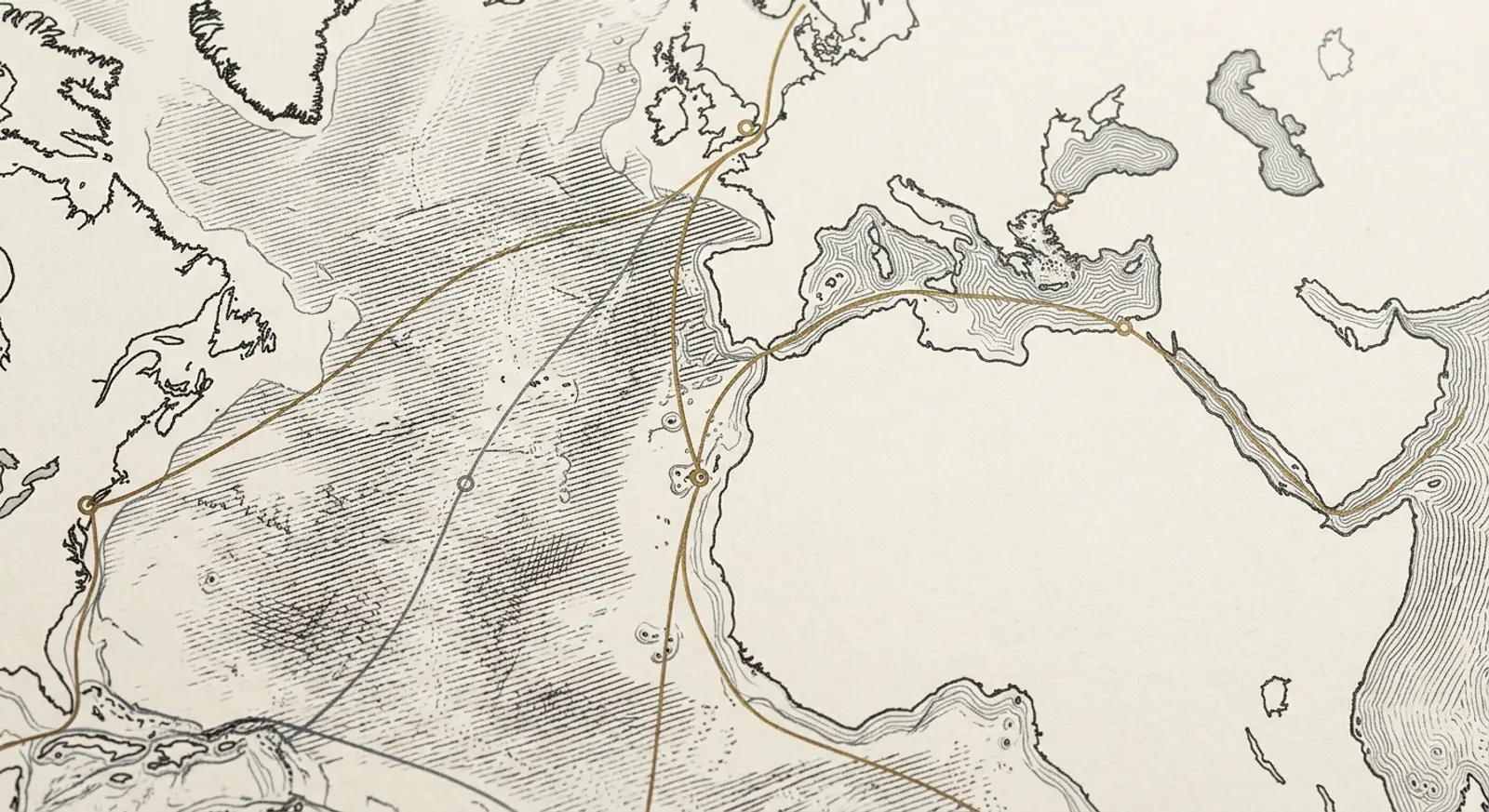
Canada, the UAE and Türkiye are not a list of markets. They are three different answers to the same question: where production, capital and market access can be combined most efficiently.
North American production, resources and institutional capital
A resource and agricultural base attached to the North American manufacturing complex, with preferential access into both the United States and the European Union through overlapping trade agreements. Deep, conservative institutional capital and predictable rule of law — and a persistent question about where value is captured versus merely extracted.
Capital formation, entrepôt trade and regional headquarters
A logistics and re-export position between Asia, Europe and Africa, layered with free-zone regimes and common-law financial centres that let ownership, treasury and operations be structured separately. Sovereign and family capital is concentrated, patient and increasingly directed at productive assets rather than passive holdings.
Manufacturing depth and the Europe–Asia land bridge
A broad industrial base inside a customs union with the European Union, positioned across the land routes connecting Europe, the Middle East and Central Asia. Competitive manufacturing and a substantial domestic market sit alongside genuine macro-financial volatility, which is a variable to be priced rather than a reason to look away.
The first notes are being prepared.
Strategic conversations. Cross-border opportunities. Economic intelligence.